
Federal cannabis rescheduling 2026 is being discussed as a real window because several forces are converging—DEA rescheduling momentum, congressional pressure, and the growing chaos of hemp-derived THC. But if you’re running a real business, you don’t bet payroll on rumors. You plan for two futures: (1) Schedule III happens, and (2) it stalls again.
This post breaks down what’s real, what’s hype, and what actions actually increase enterprise value—whether you’re a dispensary operator, a license applicant, or an investor trying to avoid becoming someone else’s “liquidity event.”
1) Why Federal Cannabis Rescheduling 2026 Is Even on the Table
There are three reasons you’re hearing “Q1 2026” instead of “someday”:
- Regulatory timeline reality. Federal rulemaking moves slowly. If rescheduling is going to land, it has to land on a timetable that fits administrative procedure and political cycles.
- Hemp-derived THC chaos is forcing the issue. The Farm Bill loophole created a de facto national intoxicant market that state-licensed cannabis businesses can’t compete with fairly—because one side is regulated and taxed like a casino, and the other side is regulated like a vitamin.
- Pressure from capital markets and states. More states = more commerce = more litigation risk = more pressure to clarify federal posture. Ambiguity is profitable for some people, but it’s a nightmare for scaling legitimate operators.
Translation: “Q1 2026” is less of a promise and more of a window where federal actors may be forced to act—because the current system is unstable and increasingly indefensible.
External resource: The DEA rescheduling process stems from HHS recommendations and administrative review under the Controlled Substances Act. For official context, see the DEA site and the Federal Register where scheduling rules are published.
2) Federal Cannabis Rescheduling 2026 and Schedule III: Win, Trap, or Both?
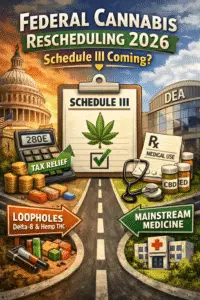 Schedule III is not federal legalization. It’s a regulatory reclassification under the Controlled Substances Act. That distinction matters because people will try to sell you “Schedule III” as the end of the war.
What Schedule III could fix immediately
- IRC § 280E relief (for federally illegal Schedule I/II trafficking). Moving to Schedule III is widely viewed as the cleanest path to removing 280E pain for state-legal operators.
- Improved lending + payments access (not guaranteed, but easier). Banks still care about compliance risk and guidance, but rescheduling shifts the risk profile.
- M&A acceleration because due diligence becomes less radioactive and modeling becomes less speculative.
What Schedule III does not fix
- It does not create interstate commerce rights for adult-use flower.
- It does not guarantee FDA pathways for THC products sold as conventional food/beverage.
- It does not stop enforcement discretion from swinging with politics.
- It may increase pharma-style compliance expectations if agencies lean into medical frameworks.
CEO reality check: Schedule III can be a valuation tailwind, but it also attracts better-funded competitors and more sophisticated compliance expectations. If your business is a mess today, rescheduling won’t save you—it will expose you.
External reference: IRS 280E is enforced through federal tax law—see the IRS official code reference here: IRS.gov.
3) The Hemp Problem Is Driving Federal Cannabis Rescheduling 2026
Here’s the uncomfortable truth: Congress accidentally created a national intoxicating THC market through hemp definitions and enforcement gaps. That market is now:
- Highly profitable for consumer brands, beverage companies, and alcohol-adjacent players.
- Structurally unfair to licensed cannabis businesses, who carry the real cost of compliance, security, testing, taxation, and zoning.
- Unsafe at the margins due to inconsistent testing, labeling games, and wildly varying state approaches.
The longer Congress stalls, the more the market solidifies around the hemp-derived ecosystem—and the harder it becomes for state-licensed operators to defend market share without price compression.
Strategic takeaway: Federal clarity may come not because Washington “supports cannabis,” but because it has to clean up the mess it created.
4) What a Smart Operator Should Do Now (Regardless of Federal Cannabis Rescheduling 2026)
Most operators are waiting for federal change like it’s a rescue helicopter. That’s not strategy. That’s a prayer.
Here’s what actually increases value in both timelines:
A) Build an audit-ready compliance spine
- Documented SOPs (inventory, intake, destruction, cash handling, security, HR).
- Training logs and incident reporting.
- Vendor compliance files and COAs.
- Data hygiene (POS, inventory reconciliation, camera retention policies).
If rescheduling accelerates capital and M&A, buyers will pay more for businesses that don’t look like a compliance time bomb.
B) Treat taxes like a balance sheet weapon
- Optimize cost accounting now (even before any 280E change).
- Prepare for rapid accounting shifts if federal posture changes.
- Fix your books so you can raise money without “trust me” spreadsheets.
C) Get bankable: underwriting is coming whether you like it or not
- Monthly financial packages.
- DSCR-focused forecasting.
- Clean contracts (leases, management, key vendors).
D) Lock down your brand and IP
- Trademark strategy (including state-based approaches where federal registration is tricky).
- Licensing-ready brand assets and quality standards.
- Clear agreements for influencers, creators, and partners.
E) Prepare for consolidation (because it’s coming)
- Know your valuation drivers.
- Know what a buyer will rip apart in diligence.
- Remove “founder risk” by systemizing operations.
5) Federal Cannabis Rescheduling 2026: The Two-Track Forecast
Track 1: Schedule III/rescheduling happens
- Tax relief improves free cash flow.
- Financing availability improves.
- M&A accelerates and valuations normalize upward for clean operators.
- Competition intensifies—especially from well-capitalized entrants.
Best move: Be “buyable” before the buyers arrive.
Track 2: It stalls (again)
- 280E remains a margin killer.
- Hemp-derived intoxicants keep siphoning consumer demand.
- Price compression continues in many markets.
- Only the operationally tight survive without dilution.
Best move: Run lean, fix cost structure, and build defensible differentiation.
6) The Real Question: Are You Building a Business or a Lottery Ticket?
If your plan is “wait for federal reform,” you’re not building a business. You’re holding a lottery ticket and calling it a strategy.
Federal reform is a multiplier. It multiplies what you already are:
- If you’re disciplined, it multiplies expansion.
- If you’re sloppy, it multiplies your problems—faster.
Bottom line: Federal cannabis rescheduling 2026 may matter. But what matters more is whether your operation is ready to take advantage of it.
Next Step: Want This Modeled for Your Business?
If you want a serious plan (not vibes), you need:
- A federal-change scenario model (Schedule III vs. no change).
- An operational and compliance readiness scorecard.
- A capital strategy that doesn’t depend on miracles.
If you want help: We work with operators and investors to build compliance-forward systems, licensing strategies, and capital plans designed to survive either federal outcome—and win when the market finally stabilizes.
Because “hope” is not a business model.