This is the program-level hub. If you’re preparing to apply for a Virginia cannabis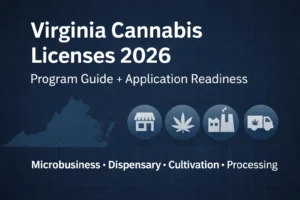 license in 2026, this page is your execution-first roadmap: license tracks, readiness requirements, timelines, and the most common ways teams get disqualified (or burn their runway before launch).
Start here: If you’re specifically pursuing retail, use the Virginia cannabis dispensary license 2026 hub. If you’re evaluating location risk, read Virginia dispensary site selection 2026.
Not legal advice: Collateral Base provides non-legal execution planning, operational readiness, and application support. For legal interpretation, regulatory filings, or contract drafting, consult qualified Virginia counsel and primary sources such as the Virginia Cannabis Control Authority and the Virginia Legislative Information System.
Table of contents
- 1) Virginia cannabis licenses 2026: program overview
- 2) License types: microbusiness, dispensary, cultivation, processing
- 3) How applications work (practical, non-legal)
- 4) Application readiness: what you must build before you apply
- 5) Timeline planning: phases and critical path
- 6) Capital + runway: why most applicants fail
- 7) Locality + zoning: the gate most teams ignore
- 8) Choose your license track (start here)
- 9) Common mistakes that kill applications
- FAQ
- Next steps
1) Virginia cannabis licenses 2026: program overview
Virginia cannabis licenses 2026 is not “one application.” It’s a program with multiple license tracks, each with different capital intensity, facility requirements, and execution risk. The fastest way to lose is to treat this like a paperwork problem. Winning applicants look like operators who can open.
Your job is to build three things at the same time:
- A credible operating plan (how you will run compliance + retail/manufacturing day-to-day)
- A credible financial plan (how you fund the build, survive delays, and reach launch)
- A credible site/locality plan (where you can actually operate, and how you get approvals)
This hub organizes the program so you can pick the right license track, build the right deliverables, and avoid the predictable failure modes.
2) License types: microbusiness, dispensary, cultivation, processing
Most applicants fall into four practical tracks. Even if the statutory taxonomy differs, this is how execution risk clusters.
Microbusiness
Best for teams prioritizing smaller footprint, lower initial capital, and tighter operational scope. Still requires serious compliance systems, SOPs, and runway planning. Microbusiness applicants often fail because they underestimate staffing, security, inventory controls, and buildout costs.
Dispensary (retail)
Retail is the most common “first idea” because it’s visible and seems straightforward. In practice, the biggest risks are locality posture, zoning/buffers, site control, buildout timelines, and cash burn while waiting on approvals.
Retail track hub: Virginia cannabis dispensary license 2026.
Cultivation (grow)
Capital-heavy, power/water/HVAC intensive, compliance-heavy, and usually slower to stabilize. Cultivation projects die from undercapitalization, facility delays, yield ramp assumptions, and operational inexperience (especially post-harvest, QA, and inventory controls).
Processing / manufacturing
Processing requires disciplined SOPs, safety systems, QA/QC, and facility design that matches the product line. The biggest failures are scope creep (“we’ll make everything”), missing quality systems, and facilities that can’t pass inspection without expensive redesign.
3) How applications work (practical, non-legal)
Regardless of the exact Virginia structure, competitive applications share the same evaluator psychology: credibility beats creativity. Evaluators want to see a team that can open safely, compliantly, and on time.
Operationally, think in these phases:
- Phase A — Build readiness: ownership/control summary, operating plan, SOP scaffolding, security plan concept, staffing plan, vendor plan, financial model, and site/locality plan.
- Phase B — Package the application: narrative consistency, exhibits, attachments, cross-references, and internal QA (red team review).
- Phase C — Post-award execution: site control finalization, permits/hearings, buildout, security installation, seed-to-sale setup, hiring/training, opening plan.
Most “application help” is really readiness help: turning a loose idea into a credible operator-grade plan with a survivable capital model.
4) Application readiness: what you must build before you apply
If you want to win, build deliverables that prove you can operate. Below is the minimum non-legal readiness stack that consistently separates serious teams from fantasies.
A) Ownership + control clarity (non-legal framing)
- Who owns what (cap table summary)
- Who controls what (decision rights summary)
- Who is responsible for compliance, finance, security, and operations
B) Operating plan that matches the license track
- Workflow diagrams (receiving → storage → sale/production)
- Inventory control approach (seed-to-sale readiness as a concept)
- Security posture (cameras, access control, storage, incident response)
- Quality controls (especially for cultivation/processing)
C) SOP scaffolding (you don’t need a novel—need a system)
Applicants get punished for vague “we will comply” language. A strong application shows a real SOP framework: titles, owners, purpose, and key controls.
Retail SOP starting point: Retail SOPs.
D) Staffing + training plan
- Org chart by launch month (who you need and when)
- Critical roles: compliance lead, inventory lead, security lead, GM/ops lead
- Training plan and accountability (checklists, audits, remediation)
E) Vendor plan (don’t “wing it” post-award)
- Security integrator short list
- Architect/GC (if buildout required)
- Seed-to-sale / POS vendor short list
- Banking/merchant processing strategy (if applicable)
F) Site + locality plan
Even the best application can die if your site cannot be approved. Locality posture, zoning/buffers, and permitting are gate issues—not “details later.”
Retail locality guide: Virginia dispensary site selection 2026.
5) Timeline planning: phases and critical path
Virginia cannabis licenses 2026 success is mostly a critical path problem. You are managing dependencies, not writing essays.
Plan around these reality-based timeline blocks:
- Readiness build (weeks to months): deliverables, SOP framework, financial model, site/locality work
- Application packaging (weeks): narrative consistency, exhibits, red-team QA
- Award-to-open (months): permits/hearings, buildout, security installation, system setup, hiring/training
Timeline guide (retail): timeline & milestones.
6) Capital + runway: why most applicants fail
The #1 execution failure is not “paperwork.” It’s running out of money while waiting. Virginia cannabis licenses 2026 is a delay-prone environment: locality process, permitting cadence, construction lead times, vendor lead times, and regulatory approvals.
Strong teams model three cash realities:
- Pre-award burn: planning, consultants, site investigation, early deposits, admin costs
- Post-award cash cliff: buildout, security, systems, hiring, inventory (retail), facility ramp (grow/processing)
- Delay buffers: 90–180 days of additional runway for permitting/construction surprises
Retail model: Virginia dispensary capital & runway model.
7) Locality + zoning: the gate most teams ignore
State authorization is not the same as local permission. Many applicants waste months chasing “perfect” properties that are politically or procedurally impossible.
Non-negotiable steps:
- Shortlist localities (3–5) before you commit to a site
- Verify zoning and buffers like an auditor (map + ordinance + measurement method)
- Secure site control with survivable downside (LOI/option/contingent lease)
- Prepare for hearings with visuals, security posture, and calm responses to common objections
8) Choose your license track (start here)
Pick the track that matches your capital, experience, and execution capacity. Each track has different failure modes. These pages will route you to the right spoke content (requirements, scoring strategy, readiness plans).
- Microbusiness: (create) /virginia-cannabis-microbusiness-license-2026/
- Dispensary (retail): Virginia cannabis dispensary license 2026
- Cultivation: (create) /virginia-cannabis-cultivation-license-2026/
- Processing: (create) /virginia-cannabis-processing-license-2026/
Recommendation: if your goal is “application help that converts,” publish the track pages in this order: microbusiness → dispensary → cultivation → processing. That mirrors search behavior and capital accessibility.
9) Common mistakes that kill applications
- Vague operational plans: “we will comply” without controls, owners, and workflows.
- Fantasy financials: unrealistic buildout costs, unrealistic timelines, missing delay buffers.
- No locality plan: assuming a site can be approved because it “looks commercial.”
- Overcommitted site control: signing a lease without licensing/locality contingencies.
- No QA: inconsistent narratives across sections, missing exhibits, sloppy packaging.
- Scope creep: especially in processing (“we’ll do everything”) without systems.
- Weak team story: no operational credibility, no accountability structure.
FAQ
What is the best starting point for Virginia cannabis licenses 2026?
Start with this hub, then choose a license track page (microbusiness, dispensary, cultivation, processing). Build readiness deliverables before you draft the narrative.
Do I need a site before I apply?
Many programs reward credible site planning and control, but the correct approach is survivable site control (LOI/option/contingent lease), not a blind long-term lease. See the retail locality guide for the execution logic.
Why do most Virginia cannabis license applicants fail?
Undercapitalization, locality/zoning failures, vague ops plans, and poor QA. Most teams lose on credibility, not effort.
How much runway should I plan for?
Plan for pre-award burn, a post-award cash cliff, and a delay buffer. Use a track-specific runway model; retail differs from cultivation and processing.
Can Collateral Base help with applications?
Yes—Collateral Base provides non-legal execution planning, readiness deliverables, SOP scaffolding, financial/runway modeling, and packaging QA to make the application credible and internally consistent.
Where should I look for official Virginia updates?
Use primary sources such as the Virginia Cannabis Control Authority and the Virginia Legislative Information System (links above).
Next steps
If you want help with your application, the fastest path is:
- Pick your track (microbusiness / dispensary / cultivation / processing).
- Build readiness (ops plan, SOP framework, staffing plan, vendor plan, runway model, site/locality plan).
- Package + QA (narrative consistency, exhibits, red-team review).
Start with the retail hub if you’re pursuing dispensary: Virginia cannabis dispensary license 2026.

Virginia Cannabis Dispensary License 2026: Application Requirements & Scoring Guide
Introduction: Why Virginia’s 2026 Retail Round Matters Updated March 2026: SB 542/HB 642 passed the Virginia General Assembly on March 14, 2026. Applications open by

What a Cannabis License Consultant Actually Does (And Why It Matters)
Most cannabis license applications are not rejected because the applicant lacked capital or commitment. They are rejected because a security plan was missing a required
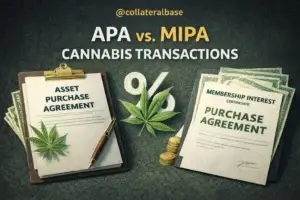
APA vs. MIPA in Cannabis: Which Deal Structure Wins?
Every cannabis acquisition comes down to a fundamental structural choice: buy the assets, or buy the entity. An Asset Purchase Agreement (APA) transfers specified assets