Virginia cannabis dispensary license 2026 hub — start there for the full picture. This guide covers Virginia dispensary site selection 2026 with a hard operational focus: how to pick the 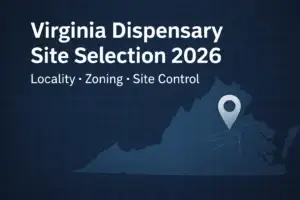 right locality, confirm zoning/buffers, secure site control (LOI vs lease), and manage the permitting and political risk that kills otherwise “great” applications.
Why this matters: in Virginia’s 2026 framework, the state may authorize retail licenses, but local government controls whether cannabis businesses are welcome and where they can operate. If you misread that landscape, you can spend months (and real money) on a location that will never open.
Not legal advice: Collateral Base provides non-legal execution planning and readiness work. For legal interpretation, regulatory filings, and contract drafting, consult Virginia counsel.
right locality, confirm zoning/buffers, secure site control (LOI vs lease), and manage the permitting and political risk that kills otherwise “great” applications.
Why this matters: in Virginia’s 2026 framework, the state may authorize retail licenses, but local government controls whether cannabis businesses are welcome and where they can operate. If you misread that landscape, you can spend months (and real money) on a location that will never open.
Not legal advice: Collateral Base provides non-legal execution planning and readiness work. For legal interpretation, regulatory filings, and contract drafting, consult Virginia counsel.
right locality, confirm zoning/buffers, secure site control (LOI vs lease), and manage the permitting and political risk that kills otherwise “great” applications.
Why this matters: in Virginia’s 2026 framework, the state may authorize retail licenses, but local government controls whether cannabis businesses are welcome and where they can operate. If you misread that landscape, you can spend months (and real money) on a location that will never open.
Not legal advice: Collateral Base provides non-legal execution planning and readiness work. For legal interpretation, regulatory filings, and contract drafting, consult Virginia counsel.
Table of contents
Updated March 2026: SB 542/HB 642 passed the Virginia General Assembly on March 14, 2026. Applications open by September 1, 2026; retail sales begin January 1, 2027; up to 350 retail licenses statewide.
- 1) Local opt-in / opt-out reality
- 2) Build a locality shortlist (fast, disciplined)
- 3) Zoning + buffer requirements (verify like an auditor)
- 4) Site control: LOI vs lease vs option (what regulators expect)
- 5) Permitting + hearings: how to avoid a public “no”
- 6) Make the site fit the business model (not the other way around)
- 7) Common mistakes that blow up site strategy
- How this fits into the full Virginia 2026 plan
- FAQ
1) Local opt-in / opt-out reality
Your first “zoning” question in Virginia is not zoning. It’s this: is the locality even open for business? Practical approach:- Start with signals: local meeting agendas, planning commission notes, economic development statements, and local press.
- Call the right people: zoning administrator, planning director, economic development office, and (politely) local law enforcement liaison.
- Score each locality: friendliness + process complexity + timeline risk + competition density + demographics.
2) Build a locality shortlist (fast, disciplined)
Do not hunt for “the one perfect building” first. Build a shortlist of 3–5 target localities, then identify multiple site options inside each. We recommend a simple matrix:- Regulatory posture: likely to allow retail cannabis; known process; staff responsiveness.
- Market fit: traffic patterns, retail adjacency, customer access, tourism/commuter dynamics.
- Competitive intensity: existing/anticipated license interest, available compliant parcels.
- Permitting friction: conditional use permits, special exceptions, overlay districts, design review boards.
- Timeline certainty: hearing cadence, staff bandwidth, election cycle risk.
3) Zoning + buffer requirements (verify like an auditor)
This is where teams make expensive, avoidable errors. You must confirm:- Use permission: which zoning districts permit cannabis retail (by-right vs conditional).
- Buffer rules: distance from schools, daycare, parks, houses of worship, etc. (state baseline + local add-ons).
- Measurement method: property line to property line? doorway to doorway? centerline? The ordinance language controls.
- Overlay districts: downtown overlays, historic districts, architectural review zones.
- Operational constraints: parking minimums, loading, signage limits, hours, security lighting rules.
- Pull the zoning map + text ordinance for the specific parcel.
- Generate a buffer map using GIS (do not eyeball it).
- Confirm permitted use and process with the zoning administrator in writing (email summary is fine).
- Confirm whether any special exceptions/conditions are common and what typically triggers denial.
4) Virginia dispensary site selection 2026: Site control: LOI vs lease vs option (what regulators expect)
For Virginia dispensary site selection 2026, do not hunt for “the one perfect building” first. Start by building a shortlist of 3–5 target localities, then identify multiple viable sites inside each locality. The fastest way to blow up Virginia dispensary site selection 2026 is falling in love with a property before you confirm the locality’s posture, process, and zoning reality. Treat Virginia dispensary site selection 2026 like a site portfolio problem—one primary site and at least one backup—so you keep leverage and protect your runway. Most licensing regimes expect you to show some level of site control. That does not always mean “sign a 5-year lease and pray.” Your job is to balance:- Credibility: regulators want to see you can actually open where you claim.
- Downside protection: you must be able to exit if you don’t win (or if the locality flips).
- LOI (Letter of Intent): cheapest and flexible; sometimes too weak if scoring expects stronger proof.
- Option to lease / option to purchase: strong credibility with controlled downside; often ideal.
- Executed lease with contingencies: strong proof but dangerous without exit clauses.
- Licensing contingency: ability to terminate if you do not obtain the license.
- Locality contingency: ability to terminate if the locality bans/opts out or denies the needed permit.
- Delayed rent / abatement: rent starts upon licensing/permitting milestones, not immediately.
- TI clarity: who pays for buildout; what happens if you exit.
- No personal guarantee unless your downside is truly modeled and acceptable.
5) Permitting + hearings: how to avoid a public “no”
Many “zoning compliant” sites still die in hearings. The failure mode is predictable: teams show up late, look unprepared, and trigger neighborhood opposition. Operational approach:- Pre-wire stakeholders: planning staff, police liaison, economic development, adjacent property owners (as appropriate).
- Bring visuals: floor plan, security plan summary, traffic/parking plan, and a clean exterior concept.
- Speak human: no cannabis jargon. Emphasize age controls, security, and normal retail behavior.
- Offer conditions proactively: lighting, cameras, staffing, queueing plans, trash control.
6) Make the site fit the business model (not the other way around)
Site selection is not just “can we get approved?” It’s “can we operate profitably?” Match the site to the model:- Downtown storefront: high visibility, more walk-ins, often stricter design review + parking constraints.
- Suburban strip retail: easier parking/queueing, lower friction, but signage and tenant mix matters.
- Standalone building: best control, often higher costs and longer permitting/buildout.
7) Common mistakes that blow up site strategy
- Starting with a building instead of a locality: you fall in love with a site that can’t be approved.
- Assuming buffers “probably work”: one wrong measurement can kill the entire location.
- Overcommitting to one site: landlords gain leverage; you lose optionality.
- Signing a lease without real contingencies: you pay rent while waiting on politics.
- Ignoring historic/overlay review: months of delay you didn’t model.
- Waiting to build community support: opposition fills the vacuum.
- Not modeling TI/buildout costs early: “cheap rent” becomes a high-cost trap.
How this fits into the full Virginia 2026 plan
Site and locality strategy is the foundation for everything else:- Capital: the locality process changes your burn and runway. Use the capital & runway model to avoid undercapitalization.
- Timeline: permitting cadence drives your realistic opening schedule. See the timeline & milestones guide.
- Readiness: your operating plan and SOP scaffolding should match the site constraints (security, flow, storage). (Link your readiness checklist spoke here once published.)
- Application packet: site credibility and locality alignment strengthen narrative consistency and scoring assumptions.